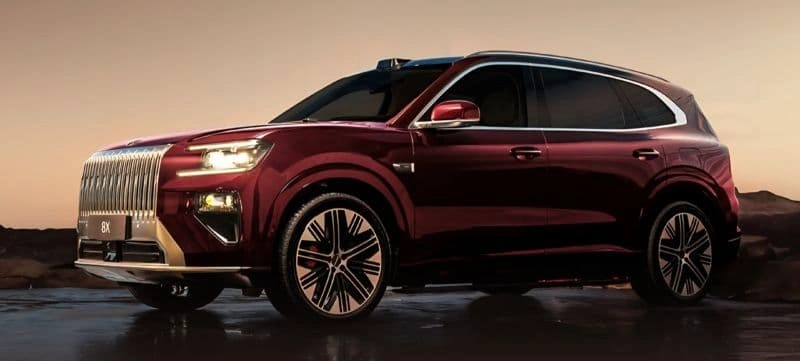
Unlike many Chinese SUVs in a category competing for the title of “best mobile lounge,” the Zeekr 8X focuses more on chassis dynamics and feedback.
Positive early consumer reactions have been seen in terms of order volume, with reports stating that 10,000 orders were achieved within 30 minutes of the sale opening time due to the powerful hybrid powertrain outputting a total of 1,381 hp in the top-tier Yao Ying specification.
The Zeekr 8X Ultra Plus version under test represents a higher-level version of the car series with an MSRP of 399,800 RMB (55,500 USD). Export versions of the car will be launched after the Zeekr 9X with deliveries starting after late 2026.
Also Read : New BYD Atto 3 Launching May 21 with 630 km Range
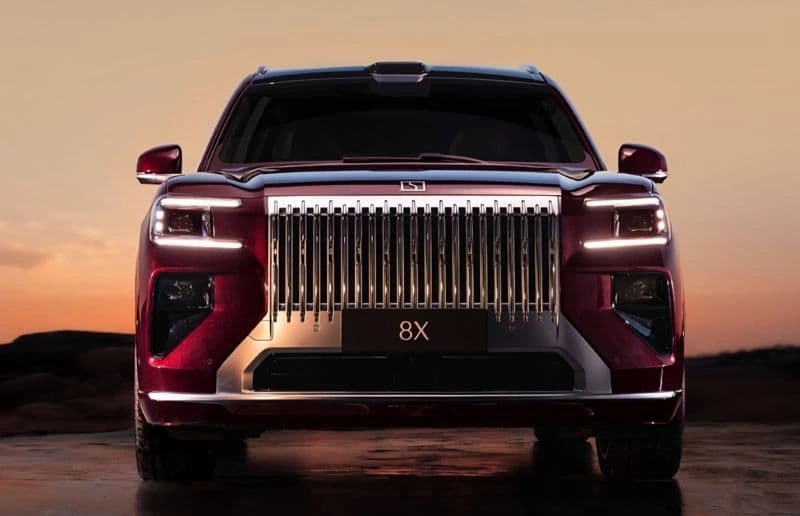
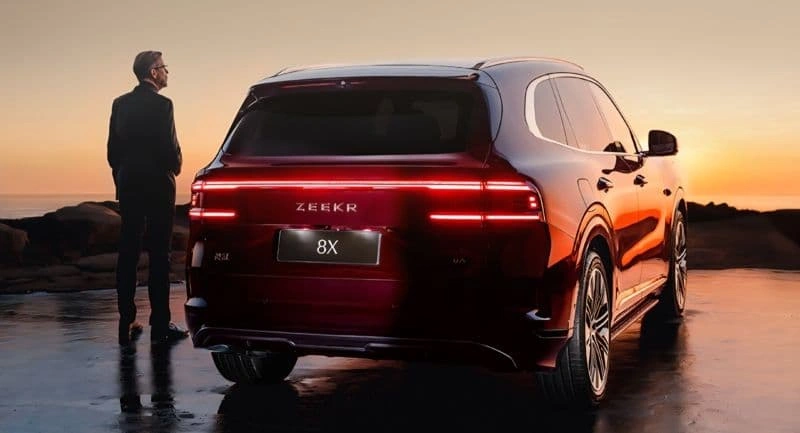
Zeekr 8X has a body length of 5100 mm and a wheelbase measuring 3069 mm. The front overhang is longer than in some competing vehicles because of the longitudinally placed 2.0T engine, making it have a longer L113 ratio.
Aerodynamic systems in the car comprise active grille shutters for both top and bottom intakes that close when there is low need for cooling. Matrix LED lights are employed on the tested trim variant.
There is one lidar sensor fitted at the roof of the Ultra Plus test vehicle. There are no other lidars found on this trim level.
The wheel size is 22 inches and the tire width is 275 sections. This configuration focuses on increasing grip rather than minimizing rolling resistance and tire noise. There are no hidden door handles on the tested vehicle.
Height adjustment is also provided through the air suspension system, which raises ground clearance by 5 cm for off-road use and lowers the vehicle body by 3 cm at higher speeds. Other exterior features include a reinforced roof rack and an external power supply rated at 2200 W.
The system utilizes a dual-screen design, featuring an infotainment screen in the center and another on the passenger side. The performance during testing was consistent in terms of navigation, media use, and multitasking.
There are physical controls for several critical actions such as switching between drive modes and adjusting the ride height, which can be done without touching the screen while driving.
Coverage by materials is good in places where it needs to be. There are soft touchpoints in the cockpit and door panels, wood for the doors inserts, and suede-type material for the headliner. All seat-related controls are located in the door panels.
All panels have a consistent placement and transition between materials. The wooden panels demonstrate good consistency of texture. There is inconsistency with diffuse light, as point sources are visible, not a line strip.
Also Read : Xiaomi YU7 GT Spotted with 990 HP Ahead of Launch
The front seat offers decent lateral support that helps to stabilise passengers while accelerating. In the rear compartment, there are electronically controlled seats along with tray tables and a compressor refrigerator in the centre console. A smaller control display is located at the back as well, but its redundant nature renders it ineffective.
The Zeekr 8X Ultra Plus features a SEA-S (Haohan-S) super hybrid platform. The hybrid powertrain comprises a 2.0T engine capable of 205 kW of power, while the dual motor produces a combined output of 660 kW (885 hp).
The vehicle uses a 70 kWh battery on a 900 V architecture. It has 6C fast-charging capability, allowing the battery to be charged from 20 to 80 percent in about nine minutes when conditions are favorable. The all-electric range of the vehicle stands at 410 km (CLTC), and the combined range varies based on conditions.
The acceleration to 100 km/h is around 3.7 seconds. The power transfer is instantaneous and well-controlled, with a linear increase in output. Under normal driving conditions, the power output is throttled down slightly to ensure a smooth ride.
The braking system provides reliable initial engagement. Nonetheless, the shift from regenerative to mechanical braking is non-linear at lower speeds, and manual control of the brake pedal is needed to ensure consistent braking performance.
The chassis incorporates an independent double wishbone front suspension with multi-link rear suspension, in addition to dual chamber air suspension and adjustable dampers. At the standard setting, there is medium level compliance in controlling the vertical motion. Sport settings increase damping and reduce ride height, which enhances the body control.
The active electronically controlled anti-roll bars are utilized for adjusting the roll stiffness during the dynamic driving. During cornering, the anti-roll bar minimizes the body roll and allows increased wheel articulation during low traction.
The steering feel is precise without much play due to its directness. Nevertheless, the absence of rear steering increases the turning radius compared to some competing models.
There were two limitations in the vehicle’s design. First, at highway speeds, there is tyre noise as the major source of NVH effect due to wide tyres (275 mm) and large wheels (22 inches). Second, rear shock absorbers have a stiffer setting, transmitting more vertical shocks than the front suspension.
Ultra Plus is equipped with lidar-driven driver-assistance technology featuring one lidar mounted at the roof and cameras and radar as supporting sensors.
In testing, lane centring and adaptive cruise control functions worked reliably without sudden failures. The performance of sensor fusion was quite steady in normal driving scenarios.
More advanced versions of the same technology with greater computing power – 1400 TOPS in the case of high-end variants of Zeekr 8X series – use more sophisticated sensor systems. However, the tested model did not include such technology.
The Zeekr 8X Ultra Plus falls into a segment where Li Auto L7, Aito M7, and BMW X5 plug-in hybrid are its competitors. Its starting price ranges from 329,800 yuan (45,800 USD), making the vehicle fall within the price range for premium large electrics in China.
When compared to the competition, the Zeekr 8X stands out thanks to its 900-volt electrical setup, dual-motor power of 660 kW, and electronic active anti-roll bar technology. The Li Auto L7 prioritizes efficient performance and spaciousness, Aito M7 highlights its software capabilities, and the BMW X5 plug-in hybrid is characterized by mechanical excellence but cannot match the electrical setup or peak power.
Starting at 329,800 yuan (45,800 USD), the Zeekr 8X Ultra Plus is among the few large premium SUVs in its price category to feature 900V electrical architecture, power from two electric motors of 660 kW, and an active anti-roll system.
In terms of the brand, Zeekr’s sales figures hit 59,466 per quarter in Q1 2026, marking a 48.3 percent increase from the previous year, according to China EV DataTracker. This figure serves as a backdrop for the 8X, which acts as a stabilizing factor for the brand amidst increasing competition in the 400,000 yuan ($55,500) price range.